Exploitative Aggression vs GTO at Low Stakes
Game-theory optimal (GTO) play aims for strategies that cannot be exploited. Exploitative play aims to print against the mistakes in front of you. At low stakes, those mistakes are often large — and still not a license to invent population stats. This page compares the two approaches, shows the fold-equity and MDF math, and walks labelled hypothetical examples.
Pair with LAG vs TAG, the LAG strategy guide, the Should I Fire? calculator, the fold-equity chart and the MDF chart.
Quick definitions
GTO (game-theory optimal) strategies are (near) unexploitable against a perfect opponent. They balance value bets and bluffs so that pure bluffs break even when the defender continues at minimum defense frequency (MDF). Studying GTO builds ranges, frequencies and a ceiling for how good "correct" play can be.
Exploitative aggression changes those frequencies when a real opponent is clearly off-frequency: more bluffs when they overfold, fewer when they never fold, thinner value when they call too wide. Controlled Chaos is exploitative LAG with a leash — fire when the number and the player both clear, stop when they do not.
Exploitative vs GTO at a glance
| Dimension | GTO-leaning baseline | Exploitative aggression (low stakes) |
|---|---|---|
| Goal | Don't lose to a perfect adversary; stay balanced | Maximise EV against the players actually seated |
| Bluff frequency | Sized to make defender indifferent at MDF | Higher vs overfolders; near-zero vs stations |
| Value betting | Sized and chosen for range balance | Thinner and often larger vs sticky callers |
| When it prints | Tough games, strong regs, when you lack a read | Soft games with clear folds or clear calls |
| Main risk | Leaving money on the table vs obvious leaks | Imagining a leak that isn't there; getting counter-exploited |
| Math you lean on | MDF, range construction, equity distributions | Break-even fold % vs observed fold rate; stop-firing filters |
| Bankroll / ego need | Patience; smaller edges per hand | Discipline to shut bluffs off; humility when the read is wrong |
The shared math: fold equity and MDF
For a pure bluff (no equity when called), break-even fold frequency is:
Folds needed = bet ÷ (bet + pot)
The defender's complementary frequency — minimum defense frequency — is:
MDF = pot ÷ (pot + bet)
They always add to 100%:
| Bet size | Example | Folds a pure bluff needs | MDF (must continue) |
|---|---|---|---|
| ⅓ pot | $10 into $30 | 25% (10÷40) | 75% (30÷40) |
| ½ pot | $20 into $40 | 33% (20÷60) | 67% (40÷60) |
| ⅔ pot | $40 into $60 | 40% (40÷100) | 60% (60÷100) |
| Pot | $50 into $50 | 50% (50÷100) | 50% (50÷100) |
| 1.5× pot | $75 into $50 | 60% (75÷125) | 40% (50÷125) |
| 2× pot | $100 into $50 | 67% (100÷150) | 33% (50÷150) |
Rounded to the nearest percent where the exact value is recurring (½ pot folds needed = 33.3%…, MDF = 66.7%…). Full charts: fold equity and MDF.
Illustrative low-stakes fold rates (assumptions, not population data)
Important: the fold rates below are labelled hypothetical assumptions for teaching the EV comparison. They are not claimed player-pool statistics from any poker site, room or study.
| Illustrative opponent | Assumed fold % to a ½-pot river bet | vs 33% break-even | Exploitative lean |
|---|---|---|---|
| Fit-or-fold recreational (hypothetical) | 55% | Well above 33% | Bluff more; delayed barrels and smaller sizes print |
| "Balanced" defender at MDF (hypothetical) | 33% | Exactly break-even for pure bluffs | Stay near a GTO bluff frequency |
| Calling station (hypothetical) | 15% | Far below 33% | Turn bluffs off; value thinner and bigger |
EV of a pure $20 bluff into a $40 pot (risk $20 to win $40):
- If they fold 55%: EV = 0.55×40 − 0.45×20 = 22 − 9 = +$13.
- If they fold 33.3%: EV = (1/3)×40 − (2/3)×20 = 40/3 − 40/3 = $0.
- If they fold 15%: EV = 0.15×40 − 0.85×20 = 6 − 17 = −$11.
Same bet size. Three different worlds. That is the exploitative case in one formula. Run your own assumed fold % in the calculator before you invent a story about "the population."
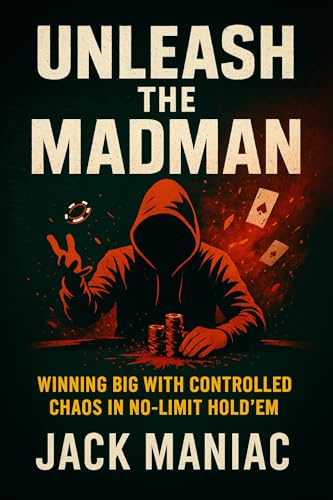
Want the Controlled Chaos playbook?
Unleash the Madman by Jack Maniac is a short No-Limit Hold'em guide to loose-aggressive play with a leash: fold equity, the Tilt Trigger System, and when to stop firing.
$9.99 on Kindle, or read it on Kindle+
Labelled hypothetical: one river, three approaches
Setup (hypothetical): $1/$2, pot $80 on the river. You have a missed draw. Board is dry. Villain checks. You consider a $50 bet ($50 into $80 ≈ 62.5% pot). Pure-bluff break-even: 50 ÷ (80 + 50) = 50 ÷ 130 ≈ 38.5% folds. MDF for the defender: 80 ÷ 130 ≈ 61.5%.
GTO-leaning line
You only bluff this river with a frequency that matches your value range and the size. If your range is value-heavy here, you bluff rarely. You are protected if villain is tough and near-balanced. You may leave money on the table if this specific villain is a chronic overfolder.
Exploitative line — assumed overfolder
Assumption (not a pool stat): you have seen this player check-fold similar rivers about two times in three tonight (illustrative observation in this hand history, not a claim about all $1/$2 players). If the true fold rate is ~67%, well above 38.5%, the $50 bluff is strongly +EV. Fire.
Exploitative line — assumed station
Assumption: same player showed down a weak third-pair call earlier and almost never raises. Fold rate to rivers looks low. Even if you only assign 25% folds, EV of the pure $50 bluff is 0.25×80 − 0.75×50 = 20 − 37.5 = −$17.50. Check back. Move the aggression to thinner value on later streets when you make a hand. That is Controlled Chaos: the aggression moves; it does not disappear into a black hole.
When GTO is the better default at low stakes
- No reliable read yet. First orbit, new player, no showdowns — don't invent a 70% fold rate.
- The table is full of thinking regs. Soft-game exploits get mirrored and punished.
- You notice yourself storytelling. "Everyone folds to overbets here" with no evidence is ego, not exploitation.
- Multiway pots. Combined fold equity collapses (two players each folding 40% → both fold only 16%). Default to higher standards for bluffs; see the stop-firing notes.
When exploitative aggression makes the money
- Clear overfolders in the blinds and on scare cards — raise more, barrel more, size to the break-even you need.
- Clear stations — cut bluffs, widen value, size up. The LAG guide five rules cover this.
- Named tilt types — Steaming, Chasing, Turtle, Revenge each demand a different frequency shift; see tilt system vs mental-game advice and the tilt check.
- Image moments after you show a monster — temporary overfolds from opponents who just paid you off.
Log the decision on the session tracker and practice with Hand of the Day. Grade the decision, not the result.
How to blend them
- Study GTO enough that you know what "balanced" looks like — so you can see deviations.
- Default near baseline until a read is earned.
- Exploit hard when the read is specific and recent; stop when two stop-firing signals appear.
- Never confuse an illustrative assumption with a database. If you write a fold % down, label where it came from (tonight's showdowns, not "the population").
Semi-bluffs change the break-even
MDF and "folds needed = bet ÷ (bet + pot)" assume a pure bluff with zero equity when called. A semi-bluff with outs needs fewer folds. Rough intuition: if you still win W of the time when called (after accounting for further action), the required fold frequency drops. The free calculator folds outs into the same decision so you are not guessing.
Labelled hypothetical: pot $60, you bet $40 (⅔ pot) with a flush draw that has about 9 outs (~19% to hit next card, ignoring further streets for a moment). Pure-bluff break-even would be 40%. With meaningful equity when called, the same bet can be +EV at a lower fold rate — which is why Controlled Chaos loves semi-bluffs against players who fold some of the time, and still refuses pure air against stations.
What this page is not
It is not a claim that GTO study is useless at $1/$2, and it is not a claim that any solver output or training site is wrong. GTO is the map of unexploitable baselines. Exploitative aggression is how you spend chips against a specific leak you can actually point to. Inventing "the pool folds 70% here" without evidence is neither. For style choice (LAG vs TAG) see the comparison; for practical LAG rules see the strategy guide.
FAQ
Should I play GTO or exploitative at low stakes?
Use GTO as the baseline when you lack a read or face strong players. Shift to exploitative aggression when a specific opponent clearly overfolds or never folds — and verify with break-even fold % math.
What is MDF in poker?
Minimum defense frequency: pot ÷ (pot + bet). It is how often a defender must continue so a pure bluff breaks even. It is the complement of the folds a bluff needs.
Can I use population tendencies from solvers or databases?
Only if you actually have that data for your game. This page deliberately uses labelled hypothetical fold rates instead of inventing pool statistics. Your notes from tonight beat a fake number.
Is Controlled Chaos the same as GTO?
No. Controlled Chaos is exploitative loose-aggressive play with stop rules: fire when fold equity and player type clear the bar, stop when they do not.
Free email course
Free 5-day Controlled Chaos email course — one short lesson a day on when to fire and when to stop. No fluff.
Aggression with a leash
Unleash the Madman shows you how to fire when the math says fire and stop when it says stop — fold equity, tilt reads, overbet and semi-bluff filters, from $1/$2 to $25/$50.
$9.99 on Kindle, or read it on Kindle+
More free tools and articles
How often to bluff
Bluff-to-value ratios by bet size, and how to adjust them against stations and nits.
LAG vs TAG
Controlled Chaos compared with tight-aggressive at low stakes.
LAG strategy guide
Five rules, the bluff formula, and a worked $1/$2 hand.
Best books for aggressive players
Seven books that make a betting style profitable.
Should I Fire? calculator
Fold equity, pot odds and a fire / don't-fire call.
Tilt check
Which tilt type are you, and what's the reset?
Session tracker
Stop rules, tilt log, bluffs fired and a 10-minute review.
Hand of the Day
One real spot a day with the math worked out.
Hand #10: bluff-catch a nit?
Exploit the read instead of defending to MDF.
MDF chart
Minimum defense frequency by bet size.