Poker Fold Equity Calculator & Chart
How often does your bluff have to work? Enter the pot, the bet, a fold read and your equity when called in this free fold equity calculator, or read the chart of break-even folds for every common size from a 25% pot stab to a 2× overbet. It pairs with the MDF calculator: the folds a bluff needs and the defender's MDF always add to 100%. For a full EV breakdown of calls as well as bets, use the poker EV calculator.
Fold equity calculator
The defaults match the worked example below ($100 pot, $75 bet, 40% fold read). Set equity to 19.6 to see the 9-out turn flush draw on the same bet. The EV calculator also prices calls, and the MDF calculator shows how often the defender must continue.
Fold equity chart: folds needed by bet size
| Bet size (of pot) | Folds needed (pure bluff) | Defender's MDF | Bet into a $100 pot |
|---|---|---|---|
| 25% | 20% | 80% | $25 |
| 33% (⅓) | 25% | 75% | $33 |
| 50% (½) | 33.3% | 66.7% | $50 |
| 67% (⅔) | 40% | 60% | $67 |
| 75% (¾) | 42.9% | 57.1% | $75 |
| 100% (pot) | 50% | 50% | $100 |
| 125% | 55.6% | 44.4% | $125 |
| 150% | 60% | 40% | $150 |
| 200% (2× pot) | 66.7% | 33.3% | $200 |
Break-even for a bluff with zero equity when called. MDF = minimum defense frequency, the share of his range the defender must continue with so your bluff can't profit on its own.
The formula
Folds needed = bet ÷ (pot + bet)
You risk your bet to win the pot that's already there. If he folds, you gain the pot; if he calls, you lose the bet. Break-even is the fold rate where those two cancel out, and that's your bet divided by the total of pot plus bet. Notice how quickly it climbs: a half-pot bluff needs one fold in three, but doubling the size to a pot-sized bet needs one fold in two, and a 2× overbet needs two folds in three.
The fold equity formula (EV of a bet)
The break-even number tells you when a bet stops losing. To see how much a bet makes, use the full fold equity formula:
EV = F × pot + (1 − F) × EV when called
EV when called = equity × (pot + bet) − (1 − equity) × bet
F is how often he folds. F × pot is your fold equity in dollars: the pot you collect without a showdown. For a pure bluff, equity is zero, so the called part is simply −bet and the formula shrinks to EV = F × pot − (1 − F) × bet. Set that to zero and you get the chart's bet ÷ (pot + bet).
Same turn spot as the example below ($100 pot, $75 bet, 9 outs), and your read is that he folds 40%:
- Fold equity: 0.40 × $100 = $40.00.
- Called part: 0.60 × (−$26.09) = −$15.65.
- EV of the semi-bluff: $40.00 − $15.65 = +$24.35, which beats checking ($19.57) by about $4.78.
- Same bet with no draw: 0.40 × $100 − 0.60 × $75 = −$5.00. A 40% fold rate is below the 42.9% a pure ¾-pot bluff needs.
Same bet, same read, opposite answers. The draw's equity is what turns a losing bluff into a winning semi-bluff, and the formula shows exactly how much of the profit comes from each part.
The chart is about break-even. A bluff only makes money when your opponent folds more often than the number in the table. Against a calling station who folds 15% of the time, even a 25% pot stab (which needs 20%) loses. Against a nit who folds 60%, pot-sized and 1.25× pot bluffs show a profit, and 1.5× pot is right at break-even.
Worked example: a turn semi-bluff
The pot is $100 on the turn. You hold a flush draw (9 outs) and consider betting $75, three-quarters of the pot. There are 46 unseen cards, so you hit on the river 9 ÷ 46 = 19.6% of the time.
- As a pure bluff: you'd need 75 ÷ 175 = 42.9% folds.
- When called: the river pot is $250. You win it 19.6% of the time and lose your $75 the rest, so a call costs you about $26 on average (9/46 × $175 − 37/46 × $75 ≈ −$26.09).
- Beating giving up: set fold% × $100 equal to (1 − fold%) × $26.09 and you need about 20.7% folds. The draw roughly halves the requirement.
- Beating checking: checking isn't worth zero, though. If you check and get a free river, you win the $100 pot 19.6% of the time, worth about $19.60. To beat that, the bet needs about 36.2% folds.
So the real question is: does this opponent fold to a ¾-pot turn bet more than about a third of the time? Against a thinking regular, probably yes. Against a station, no, so take the free card. The calculator, preloaded with this hand, shows the same numbers and lets you change the read.
Three things the chart can't see
Multiway pots. Everyone has to fold. If each of two opponents folds 50% of the time, both fold only 25% of the time, so a pot-sized bluff that works heads-up loses money multiway.
Future streets. The table assumes the hand ends when he calls or folds. On the flop and turn, getting raised off your equity, or firing again later, changes the math. Treat the chart as a baseline, not a solver.
Your read. The fold percentage you plug in is an estimate. Be honest about who folds: low-stakes players who "need to see it" fold far less than the textbook says, and that's when thin value bets beat bluffs.
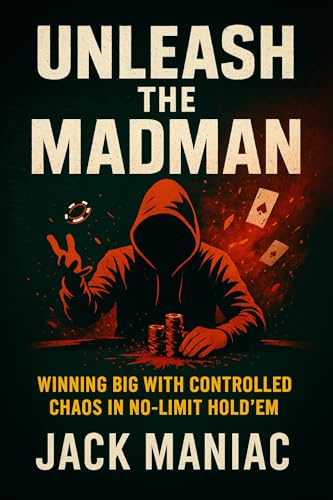
Want the full system? Unleash the Madman on Kindle ($9.99, or read it on Kindle+). A short LAG playbook covering when to fire, when to stop, and the Tilt Trigger System.
See it on Amazon →Fold equity FAQ
What is fold equity in poker?
Fold equity is the share of your bet's value that comes from your opponent folding. A bluff with no outs wins only through folds, so its fold equity is all of its value. A semi-bluff wins through folds plus the times you hit your draw when called.
How do you calculate the fold percentage a bluff needs?
Divide your bet by the pot after your bet: bet ÷ (pot + bet). A $75 bet into $100 needs 75 ÷ 175 = 42.9% folds to break even as a pure bluff.
How often does a pot-sized bluff need to work?
50% of the time. You risk one pot to win one pot, so you break even if the opponent folds half the time.
What is the fold equity formula?
EV = fold% × pot + (1 − fold%) × EV when called, where EV when called = equity × (pot + bet) − (1 − equity) × bet. For a pure bluff with no equity this becomes fold% × pot − (1 − fold%) × bet. With a $100 pot, a $75 bet and a 40% fold rate, a pure bluff loses $5 but a 9-out flush draw makes about $24.35.
Does a semi-bluff need fewer folds?
Yes. If you can still win when called, part of your profit comes from equity rather than folds. In the flush-draw example on this page, the fold percentage needed to beat giving up drops from 42.9% to about 21%, but beating a free card still takes about 36%.
Is fold equity the same as minimum defense frequency?
They are two sides of the same number. Minimum defense frequency (MDF) is pot ÷ (pot + bet), the share of hands the defender must continue with so a pure bluff can't profit automatically. The bluff's required fold % is 100% minus MDF.
How do I use the fold equity calculator?
Enter the pot, your bet, how often you think they fold, your equity when called, and how many opponents have to fold. The calculator shows the break-even fold rate (pure bluff and with your equity), the EV of the bet, how many dollars of that EV come from folds, and the combined fold chance multiway.
- Hand #1: Fire the turn with Q♦J♦?
- Hand #5: Jam the combo draw right after a bad beat?
- Hand #9: Check-raise the flop with a combo draw?
- Poker EV calculator: call, bet & bluff EV
- Push/fold chart: Nash shove & call ranges (1–20bb)
- When to raise in poker: value, bluff & isolation
- When to double-barrel in poker: fold math & filters
- How to bluff in poker: 6 rules
- How often to bluff, by bet size
- When to 3-bet in poker: fold math & filters
- When to c-bet in poker: fold math & filters
- How to play against tight players: steal math

Ready to play like a madman?
Unleash the Madman: Winning Big with Controlled Chaos in No-Limit Hold'em by Jack Maniac is the short, practical loose-aggressive playbook behind this site: the overbet and semi-bluff filters, the signs to stop firing, and the Tilt Trigger System, with hand examples from $1/$2 up.
Get Unleash the Madman: $9.99 on Kindleor read it on Kindle+Read a free sample