How to Play Small Pocket Pairs
Small pocket pairs, 22 through 66, look like real hands but play like draws. They flop a set only 11.8% of the time, and nearly every flop puts at least one overcard on top of them. Knowing how to play small pocket pairs comes down to price: how much you pay preflop compared with what you can win when the set comes. This guide covers the set-mining math, a break-even table by call size, overcard odds, early position and tournament play, and the raise-or-fold approach from Unleash the Madman by Jack Maniac.
The set-mining math
A pocket pair flops a set or better 11.8% of the time (1 − C(48,3)/C(50,3) = 2,304/19,600), about 7.5 to 1 against. To break even on the preflop call alone, you need to win about 7.5 times the call, on average, when you hit:
| Spot | Your call | Net win needed when you flop a set | At $1/$2 |
|---|---|---|---|
| Over-limp $2 at $1/$2 | $2 | about $15 | about 8 big blinds |
| Call a $6 open | $6 | about $45 | about 22 big blinds |
| Call a $10 open | $10 | about $75 | about 38 big blinds |
| Call a $20 3-bet (you opened $6, so $14 more) | $14 | about $105 | about 52 big blinds |
This is the floor, not the target. Sets sometimes lose, and you will not always get paid. That is why many players use a rule of thumb that effective stacks should be at least 15 to 20 times the call before set-mining. The dead money already in the pot and the pots you win without a set work in your favor. Related: implied odds calculator.
Why small pairs are hard to play when they miss
| Pair | Flop has an overcard | All in vs A♥K♦ | All in vs T♦T♥ |
|---|---|---|---|
| 22 | 100.0% | 53.0% | 18.8% |
| 33 | 99.9% | 53.8% | 19.2% |
| 44 | 99.4% | 54.4% | 19.7% |
| 55 | 98.1% | 55.0% | 19.7% |
| 66 | 95.8% | 55.4% | 19.7% |
Even 66 sees at least one card above it on 95.8% of flops. Preflop, a small pair is a slight favorite against two overcards (about 53.0%–55.4% against ace-king) but a big underdog against a bigger pair (under 20%). After the flop with no set, you have a weak pair that cannot stand much pressure. Exact equities come from enumerating every board. More matchups: preflop odds chart.
How to play them, by situation
- Unopened, late position: raise. You can win the blinds now, and you have position when you get called.
- Unopened, early position: open at passive tables; fold at aggressive tables where 3-bets are common, because calling a 3-bet to set-mine is usually too expensive.
- Facing a raise, deep stacks: call for set value when the table above says the price works, ideally in position and against a player who pays off.
- Facing a 3-bet: usually fold unless stacks are very deep and the 3-bettor stacks off with overpairs.
- Behind limpers: over-limp in position or raise to isolate a weak limper. Guide: when to limp in poker.
- Short stacks (tournaments, about 20 big blinds or less): there is no money behind for implied odds. Open-shove or fold. Related: when to go all in.
After the flop
- You flop a set: build the pot. Bet wet boards, where draws will pay, and do not slow-play into four-way action.
- You miss, heads-up, as the raiser: a small c-bet on dry, high boards often takes it down against tight players. Give up on later streets when called. Guide: when to c-bet in poker.
- You miss, multiway or against a calling station: check and fold to real pressure. A pair of fours does not need to see a showdown.
The Madman view: cheap flops, disciplined folds
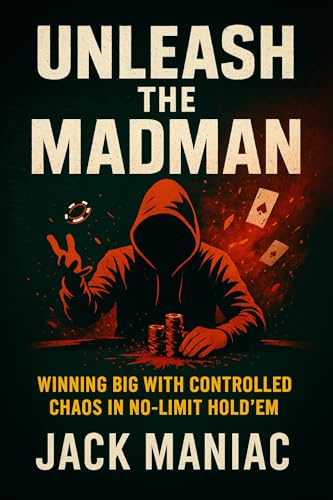
Small pairs fit the Controlled Chaos approach: put chips in when the price is right, fire when the board favors your range, and stop when the line says stop. Unleash the Madman: Winning Big with Controlled Chaos in No-Limit Hold’em by Jack Maniac is the short playbook for aggression with a leash, with hand examples from $1/$2 through $25/$50. About 41 pages: read it in one sitting, then try one adjustment at your next session. It is not for absolute beginners who still need hand rankings.
It is $9.99 on Kindle, or read it on Kindle+. Small-game plan: low stakes poker strategy.
FAQ
How should you play small pocket pairs?
Mostly for set value. Raise or call cheaply preflop when stacks are deep, see a flop, and continue strongly when you flop a set. When you miss, which is most of the time, check and give up unless the board is very low or your opponent is likely to fold to a bet.
How do you play small pocket pairs in early position?
Carefully. In early position at a full table, several players still act behind you and you may face a 3-bet, which kills set-mining odds. Many players open them from early position when the table is passive and fold them when it is aggressive. From late position they are an easy open.
How do you play small pocket pairs in tournaments?
Stack depth decides. Deep, play them like cash for set value. Around 20 big blinds or less there is not enough money behind to pay off a set, so small pairs become open-shove or fold hands, depending on position and how many players are left to act.
How often do pocket pairs flop a set?
About 11.8% of the time, or roughly 7.5 to 1 against: 1 minus C(48,3)/C(50,3), which is 2,304 of 19,600 flops. By the river it is about 19.2% if you see all five cards.
Is 22 a coin flip against ace-king?
Close to it, and slightly better. All in preflop, 2♠2♣ against A♥K♦ has about 53.0% equity. Against a bigger pair such as tens, small pairs have only about 19%.
Is there a book on aggressive no-limit hold’em for small games?
Unleash the Madman by Jack Maniac covers Controlled Chaos aggression: raising with a plan, isolating weak players, and knowing when to stop putting chips in. It is $9.99 on Kindle, or you can read it on Kindle+.
Free email course
Free 5-day Controlled Chaos email course: one short lesson a day on pricing calls with simple math, raising with a plan, and folding without tilt. No fluff.
Related guides
How to play suited connectors
Flop odds, equity and when 87s is worth a call.
How to play pocket aces
Raise to thin the field; SPR and when one pair is beaten.
How to play pocket kings
Raise like aces, then respect the ace on the flop.
When to limp in poker
Over-limp vs iso-raise, with a $1/$2 price table.
Implied odds calculator
How much you need to win later to justify a call now.
Odds of flopping
Sets, flushes, straights and more, by hand type.
Price the call, then play it with a plan.
Unleash the Madman by Jack Maniac is the Controlled Chaos playbook: when to raise, when to fire, when to stop, and the Tilt Trigger System. $9.99 on Kindle, or read it on Kindle+.
Get Unleash the Madman: $9.99 on Kindleor read it on Kindle+Read a free sample