Poker Implied Odds Calculator & Chart
Direct pot odds say fold, but stacks are deep and he'll pay you when you hit. How much more do you need to win later? Enter the pot, the bet and your outs in this free implied odds calculator to get the equity a call needs, the extra dollars you must win when you hit, and whether the stack behind can cover it. The chart below gives the same answer for a flush draw at every common bet size. Pair it with the pot odds calculator and the outs chart.
Implied odds calculator
The defaults match the worked example below ($100 pot, $50 bet, flush draw on the turn). On the flop, count one card at a time: price the turn card now, then decide again on the turn. To price a bet or bluff instead of a call, use the poker EV calculator or the fold equity calculator.
Implied odds chart: extra dollars a flush draw needs
| Opponent's bet (of pot) | You call (into $100) | Direct equity needed | Shortfall vs 19.6% | Extra $ needed when you hit |
|---|---|---|---|---|
| 25% | $25 | 16.7% | — | — |
| 33% (⅓) | $33 | 20% | 0.4% | $4 |
| 50% (½) | $50 | 25% | 5.4% | $56 |
| 67% (⅔) | $67 | 28.6% | 9% | $107 |
| 75% (¾) | $75 | 30% | 10.4% | $133 |
| 100% (pot) | $100 | 33.3% | 13.8% | $211 |
| 125% | $125 | 35.7% | 16.1% | $289 |
| 150% | $150 | 37.5% | 17.9% | $367 |
| 200% (2× pot) | $200 | 40% | 20.4% | $522 |
Assumes a flush draw with 9 outs and one card to come (9 ÷ 46 ≈ 19.6%). "—" means the draw already clears direct pot odds, so you need no extra money. Extra $ is rounded to the nearest dollar from the exact break-even formula below.
The formula
Facing a bet B into pot P, your call is C = B. Direct break-even needs
E ≥ C ÷ (P + B + C)
If your actual equity E_actual is below that, you need an additional expected win W on later streets such that
E_actual × (P + B + C + W) ≥ C
which rearranges to
W ≥ C ÷ E_actual − (P + B + C)
That W is the break-even implied amount — the extra you must win, in expectation, when you hit. If he folds the flush or stacks aren't deep enough, the real number is smaller and the call can still lose.
Worked example: $100 pot, $50 bet, flush draw
The pot is $100 on the turn. He bets $50. You hold a flush draw: 9 outs among 46 unseen cards, so E_actual = 9 ÷ 46 ≈ 19.6%.
- Direct odds: call $50 into a final pot of $200. You need 50 ÷ 200 = 25%.
- Shortfall: 25% − 19.6% ≈ 5.4%. On direct odds alone, this is a fold.
- Implied break-even: W ≥ 50 ÷ (9/46) − 200 = 50 × 46 ÷ 9 − 200 ≈ $56. You need to win about $56 more on the river when you hit.
Is $56 realistic? Against a player who calls a $50–$80 river value bet with a strong pair and that much behind, yes. Against someone who check-folds the moment the flush lands, no — take the free card or fold.
At a third of the pot you need 20%; the flush is almost there (~$4 implied). At pot size you need 33.3% and about $211 more on the river — a much taller ask.
When implied odds are real (and when they aren't)
Stack depth. You can't win more than what's left behind. If he's short $30 after the call, the $56 half-pot number is fiction.
His hand and the board. Implied odds are highest when he has a strong second-best hand he'll pay off (top pair, overpair, two pair). They're lowest on an obvious four-flush board, or when you're drawing to the low end of a straight.
Reverse implied odds. Hitting and still losing — or getting stacked by a bigger flush — cuts the other way. Non-nut draws need a bigger price, not a thinner one.
Multiway pots. More callers improve direct odds, but someone behind can still raise, and the pot often goes to the nut flush. Don't stretch implied odds multiway the way you might heads-up.
Call, fold, or turn the draw into a bet?
Implied odds answer the calling question when you're short on price. Sometimes betting is better: a semi-bluff picks up folds a call never gets. See the fold equity chart, then plug the spot into the free bluff calculator.
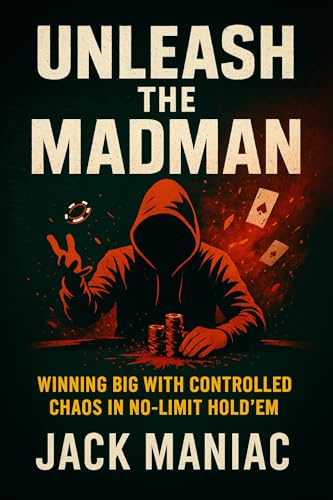
Want the full system? Unleash the Madman on Kindle ($9.99, or read it on Kindle+). A short LAG playbook covering when to fire, when to stop, and the Tilt Trigger System.
See it on Amazon →Implied odds FAQ
What are implied odds in poker?
Implied odds are the extra money you expect to win on later streets when you hit your draw. They can turn a call that fails on direct pot odds into a break-even or profitable one, but only if your opponent will actually pay you off.
How do you calculate implied odds?
First find the equity you need on direct odds: call ÷ (pot + bet + call). If your actual equity is lower, solve for the extra win W such that actual equity × (final pot + W) ≥ call, which rearranges to W ≥ call ÷ equity − (pot + bet + call).
When do implied odds justify calling a draw?
When the extra dollars you need are realistic for the stacks and the opponent. Facing a half-pot turn bet with a flush draw in a $100 pot, you need about $56 more on the river. Common vs a calling station; rare vs a nit who folds when the flush comes.
What are reverse implied odds?
The opposite risk: you hit your draw and still lose a big pot, or get paid less than you hoped because the board scares him. Non-nut flushes, weak straights and dominated overcards carry reverse implied odds.
Do implied odds replace pot odds?
No. Start with the pot odds chart. Implied odds are the adjustment when you're short on direct equity and there is still money behind to win. On the river there are no implied odds left.
- Hand #1: Fire the turn with Q♦J♦?
- Hand #7: Jam the combo draw when SPR is under 1?
- Pot odds calculator (call or fold?)
- Poker EV calculator: call, bet & bluff EV
- How to play flush draws: odds, semi-bluffs & when to fold
- When to fold in poker: price table & examples
- When to limp in poker: price table & set-mining math
- How to play small pocket pairs: set-mining math
- How to play suited connectors: flop odds & equity
- Preflop odds chart: exact all-in equity
- Exploitative vs GTO at low stakes

Ready to play like a madman?
Unleash the Madman: Winning Big with Controlled Chaos in No-Limit Hold'em by Jack Maniac is the short, practical loose-aggressive playbook behind this site: the overbet and semi-bluff filters, the signs to stop firing, and the Tilt Trigger System, with hand examples from $1/$2 up.
Get Unleash the Madman: $9.99 on Kindleor read it on Kindle+Read a free sample