Low Stakes Poker Strategy
Low stakes poker strategy is less about memorizing solver lines and more about reading the pool: sticky callers, capped aggression, and players who fold too much to pressure. This guide is the practical version — fold math, thin value, stop-firing, and tilt spotting — through Controlled Chaos from Unleash the Madman by Jack Maniac. It is distinct from the exploitative vs GTO compare and from LAG poker strategy; here the focus is day-to-day decisions that print at micro and small stakes.
What “low stakes” means in practice
Forget a single dollar cutoff. Low-stakes games tend to share the same table texture:
- Sticky players / stations who call too wide and hate folding once they have any piece.
- Capped aggression — fewer 3-bets, fewer river raises, lots of check-calls with medium hands.
- Loose preflop that creates multiway pots where thin one-pair is dominated and pure bluffs die.
Online micro-stakes and small live games ($1/$2 and neighbors) usually fit. Bigger games can still play “low stakes” in texture when the pool is recreational. No invented winrates here — only the adjustments that match what you see.
Exploitation over solvers at these games
Solvers teach balance. Low-stakes opponents leave money on the table by calling too much or folding too much. So the default is exploitative:
- Vs stations: value thinner, bluff less. Size so worse hands can still call.
- Vs folders / scared money: pressure more — barrels and well-sized bluffs print when fold equity clears the break-even line.
- Multiway: cut air bluffs; everyone must fold for a pure bluff to win.
Keep a leash. When a “station” starts folding, or a nit starts calling light, update the read. Controlled Chaos is aggression with that leash — details on the Controlled Chaos poker page.
Fold math for low-stakes bets
A pure bluff breaks even when he folds bet ÷ (pot + bet). The same size also sets the equity a caller needs: bet ÷ (pot + 2 × bet). Use both columns before you fire or value-bet:
| Bet size | Folds a pure bluff needs | Equity a caller needs |
|---|---|---|
| ⅓ pot | 25.0% | 20.0% |
| ½ pot | 33.3% | 25.0% |
| ¾ pot | 42.9% | 30.0% |
| Pot | 50.0% | 33.3% |
| 2× pot | 66.7% | 40.0% |
A half-pot bluff needs only 33.3% folds. A pot-sized bluff needs 50.0%. A 2× overbet needs 66.7%. Against a station who folds far less than those lines, stop bluffing and thin-value instead. Against a player who folds more than the line, the bluff is +EV even when it sometimes gets called. Full ladders: fold equity chart and how often to bluff.
Pillar 1: Stop firing at calling stations
The same barrel that prints against a nit is a donation against someone who “needs to see it.” Pull bluffs out of your range, leave thin value in, and wait for better spots. The field guide is stop firing at calling stations.
Pillar 2: Thin value instead of hopeful bluffs
When he calls too wide, bet hands that beat enough of that calling range. A half-pot value bet needs you to be ahead 25.0% of the time vs the hands that call; a pot bet needs 33.3%. Size so second pair and weak kickers can still pay. Full worked example: thin value bet poker.
Pillar 3: Spot tilt and pressure it
Low-stakes games are full of players who are stuck, steaming, or chasing. The book’s Tilt Trigger System is built for that: spot the tell, pressure the ones who fold or call the wrong amount, and protect your own stack with a stop rule. Use how to stop tilting for your own state and the Tilt Trigger System article for opponents.
Worked example: same $75 bet, opposite results
You bet $75 into a $100 pot. Break-even as a pure bluff is 42.9% folds. Against a player who folds 55%, EV = 0.55 × $100 − 0.45 × $75 = +$21.25. Against a station who folds only 25%, EV = 0.25 × $100 − 0.75 × $75 = −$31.25. Same cards, same size. At low stakes the read decides the line — not a generic “always barrel” rule. More on who to bluff: how to bluff in poker.
Learn it from Unleash the Madman
Unleash the Madman: Winning Big with Controlled Chaos in No-Limit Hold’em by Jack Maniac is the short playbook these pillars come from. It covers stop-firing against sticky players, thin value, overbet and semi-bluff filters, and the Tilt Trigger System — with hand examples from $1/$2 through $25/$50. About 41 pages: one sitting, then try one adjustment at your next session. It is not for absolute beginners who still need hand rankings.
It is $9.99 on Kindle, or read it on Kindle+. Related: how to play aggressive poker and how to be a winning poker player.
FAQ
What is considered low stakes poker?
In practice, low stakes means games where many players call too wide, aggression is capped, and stacks or buy-ins keep decisions from getting huge. Online micro-stakes and small-stakes live cash ($1/$2 and nearby) fit that description. Exact dollar bands vary by room and city — the player pool matters more than the blind size.
What is the best low stakes poker strategy?
Exploit the pool: value thinner against sticky players, bluff less against stations, pressure opponents who fold too much, and run every bluff through fold math. Solver-perfect lines matter less when opponents leave money on the table by calling or folding the wrong amount.
Should you play GTO or exploitative at low stakes?
Exploitative first. At low stakes, most opponents are not balancing ranges. Adjust to what they actually do — see the dedicated compare page on exploitative vs GTO at low stakes — then keep a leash so you do not spew when the exploit stops working.
Is Unleash the Madman good for low stakes?
Yes. Unleash the Madman by Jack Maniac is a short Controlled Chaos playbook built for sticky, capped games: stop-firing at calling stations, thin value, overbet filters, and the Tilt Trigger System. It is $9.99 on Kindle, or you can read it on Kindle+. It is not for absolute beginners who still need hand rankings.
Free email course
Free 5-day Controlled Chaos email course: one short lesson a day on low-stakes adjustments: value thinner, bluff less vs stations, and pressure folders. No fluff.
Related guides
Starting hands chart
Which hands to raise from every seat, 6-max and 9-max.
Poker rake calculator
What the rake costs you per hour, and how to beat it.
Where to play poker online
Bovada vs BetOnline for practicing the book's lines at low stakes.
Controlled Chaos poker
Aggression with a leash: the system behind the book.
How to play against tight players
Steal from nits with fold math, and fold to their big bets.
How to play aggressive poker
7 steps from passive to aggressive, with fold math.
When to limp in poker
When an over-limp is fine, and when to raise or fold instead.
Thin value bet poker
When to bet for value instead of bluffing — especially vs stations.
How to play against calling stations
Stop bluffing sticky callers; value thinner instead.
Stop firing at calling stations
Value thinner, bluff less — the station adjustment.
When to c-bet in poker
Continuation-bet fold math: when to fire and when to check.
Exploitative vs GTO at low stakes
When to deviate from balanced lines in sticky games.
How to be a winning poker player
Habits that turn break-even play into winning play.
When to 3-bet in poker
Preflop re-raise fold math: when light 3-bets print.
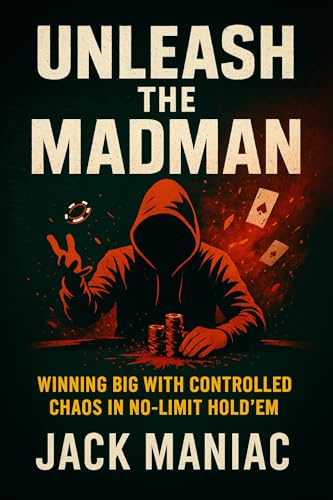
Low stakes reward Controlled Chaos.
Unleash the Madman by Jack Maniac is the short No-Limit Hold’em playbook for sticky games: stop-firing, thin value, overbet filters, and the Tilt Trigger System. $9.99 on Kindle, or read it on Kindle+.
Get Unleash the Madman: $9.99 on Kindleor read it on Kindle+Read a free sample