When to Check-Raise in Poker
A check-raise is checking first, then raising when someone bets. Knowing when to check-raise in poker — value, semi-bluff, or skip — beats auto-raising every stab. This guide covers the meaning, fold math for common raise sizes, when check-raises print (folders, polar boards, draws), when they fail (stations, multiway), and a worked EV example. It sells the Controlled Chaos leash from Unleash the Madman by Jack Maniac. For the raw sizing ladder, use the check-raise chart; for facing aggression, see how to play against aggressive players.
Check-raise meaning
You are first to act. You check. He bets. You raise. That line can be a trap with the nuts, a semi-bluff with a draw, or a pure bluff that needs folds. Check-raises put more money in relative to the pot than a simple c-bet — so the fold target is higher and the mistake of raising air at a station is more expensive.
Fold math for common raise sizes
Setup: pot is $100, villain bets $50 (½ pot), pot facing you = $150. A pure bluff breaks even when he folds raise-to ÷ (pot facing + raise-to). He needs equity of raise-to ÷ (pot facing + 2 × raise-to) to call. MDF is the complement:
| Raise to | Folds needed | Caller equity needed | Bettor MDF |
|---|---|---|---|
| 2× bet ($100) | 40.0% | 28.6% | 60.0% |
| 2.5× bet ($125) | 45.5% | 31.2% | 54.5% |
| 3× bet ($150) | 50.0% | 33.3% | 50.0% |
| 3.5× bet ($175) | 53.8% | 35.0% | 46.2% |
| 4× bet ($200) | 57.1% | 36.4% | 42.9% |
A 2× raise ($100) needs 40.0% folds. A 2.5× needs 45.5%. A 3× ($150) needs 50.0%. A 3.5× needs 53.8%. A 4× needs 57.1%. Compare: a half-pot c-bet only needs 33.3% folds — check-raises sit closer to the overbet band. Pair with the fold equity chart and MDF chart.
When to check-raise
- Bettors who fold enough. A pure 3× check-raise needs 50.0% folds. If this player folds more than that to raises, light check-raises print at that size.
- Value with nutted hands. Sets, two pair, and strong draws that improve to value want to build a pot against a betting range full of one-pair and air.
- Semi-bluffs with real equity. A flush draw hits the turn about 19.1% (9 of 47) and gets there by the river about 35.0%. You can raise for folds and keep equity when called — see the semi-bluff chart.
- Boards that favor the check-raise story. Connected, two-tone flops and scare cards that complete draws you represent make your raise believable.
Value wants calls from worse. Bluffs want folds. Smaller raises (≈2–2.5×) keep the fold target lower and lose less when called — useful with draws.
When not to check-raise
- Calling stations. If he folds far less than 50.0%, a 3× bluff check-raise is an expensive gift. Check-call value or check-fold air — full guide: how to play against calling stations.
- Multiway pots. Everyone must fold. Two opponents each folding 50% leave a pure bluff winning only 25.0% of the time (0.5 × 0.5). Each folding 40% leaves only 16.0%. Skip most bluff check-raises multiway.
- No plan for later streets. Pure air that gets called with no outs and no barrel plan is just a bigger pot you will lose. Prefer check-call with showdown value or check-fold.
Worked EV example: raise to $150 into $150 (3×)
Pot $100, he bets $50, you check-raise to $150 as a pure bluff. Break-even is 50.0% folds. Bettor MDF is 50.0%; he needs about 33.3% equity to call.
- If he folds 60%: EV = 0.60 × $150 − 0.40 × $150 = +$30.00.
- If he folds only 40%: EV = 0.40 × $150 − 0.60 × $150 = −$30.00.
Same size, opposite result. Against the sticky bettor, check-call a real hand or give up. Bluff construction: how to bluff in poker. Preflop aggression that builds these pots: when to 3-bet in poker.
Learn check-raise aggression from Unleash the Madman
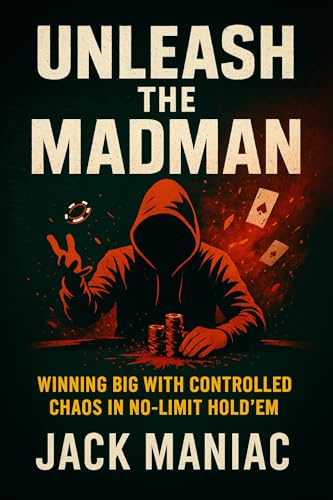
Unleash the Madman: Winning Big with Controlled Chaos in No-Limit Hold’em by Jack Maniac is the short playbook for aggression with a leash: when to raise, when to check-call, semi-bluff lines, and stop-firing against sticky players — with hand examples from $1/$2 through $25/$50. About 41 pages: one sitting, then try one adjustment at your next session. It is not for absolute beginners who still need hand rankings.
It is $9.99 on Kindle, or read it on Kindle+. Number ladder: check-raise chart. System outline: Controlled Chaos poker.
FAQ
What is a check-raise in poker?
A check-raise is checking when first to act, then raising after an opponent bets. You can do it for value with a strong hand, as a semi-bluff with a draw, or as a pure bluff. The raise size decides how often the bettor must fold for a pure check-raise bluff to break even.
When should you check-raise?
Prefer heads-up pots, bettors who fold enough for your size, boards that favor your checking range (or scare cards that complete draws you represent), and hands with equity when called — sets and two pair for value, flush/OESD combos as semi-bluffs. Smaller raises (≈2–2.5×) keep the fold target lower.
When should you not check-raise?
Multiway pots (everyone must fold), sticky bettors who almost never fold to a raise, and pure air with no later-street plan. A half-pot c-bet only needs about 33% folds; a 3× check-raise into that bet needs 50% — bring outs or a clear fold target.
Is there a book on check-raise aggression with a leash?
Unleash the Madman by Jack Maniac covers Controlled Chaos aggression: when to raise, when to check-call, semi-bluff lines, and stop-firing at sticky players. It is $9.99 on Kindle, or you can read it on Kindle+. Pair this guide with the check-raise chart for the number ladder.
Free email course
Free 5-day Controlled Chaos email course: one short lesson a day on when to check-raise, when to check-call, and how to size with fold math. No fluff.
Related guides
How to play flush draws
When to raise a draw and when to just call.
Check-raise chart
Folds, MDF and caller equity for 2×–4× raises.
When to 3-bet in poker
Preflop re-raise fold math: when light 3-bets print.
How to bluff in poker
6 rules: who to bluff, sizing, semi-bluffs and when to stop.
Semi-bluff chart
How outs lower the fold target on check-raise draws.
When to donk bet in poker
The other OOP line: lead into the raiser instead of check-raising.
Check-raise with a plan, not a hope.
Unleash the Madman by Jack Maniac is the Controlled Chaos playbook: when to raise, when to stop, semi-bluff lines, and the Tilt Trigger System. $9.99 on Kindle, or read it on Kindle+.
Get Unleash the Madman: $9.99 on Kindleor read it on Kindle+Read a free sample