How to Bluff in Poker
Bluffing in poker is betting so a better hand folds. It works when you pick the right player, tell a believable story, and size the bet so he only has to fold a realistic share of the time. This guide is the practical version: six rules, the fold math, and a worked river bluff. It follows the Controlled Chaos approach from Unleash the Madman by Jack Maniac.
1. Bluff players who can fold
The best bluff in the world loses to someone who never folds. Before you bet, ask one question: has this player shown he can let a hand go? Tight, careful regulars and players who are scared money fold often. Calling stations and players who are stuck and steaming do not. Against them, stop bluffing and value-bet thinner instead (more on that in stop firing at calling stations).
2. Tell a story that makes sense
Your bet has to match a hand you could really have. If you raised preflop and the board comes A-K-x, you have lots of strong hands and he knows it, so a bet is believable. If you called preflop and the board is low and connected, your bet on the river looks like it came from nowhere. Think about how the whole hand looks from his seat, not just how weak his hand might be.
3. Size the bet with fold math
A pure bluff breaks even when he folds bet ÷ (pot + bet) of the time:
| Bet size | He must fold at least |
|---|---|
| ⅓ pot | 25.0% |
| ½ pot | 33.3% |
| ¾ pot | 42.9% |
| Pot | 50.0% |
| 2× pot | 66.7% |
Smaller bets need fewer folds but get called more by weak hands. Bigger bets, including overbets, need more folds but put real pressure on capped ranges. Pick the size that matches how often this player folds in this spot. The full tables are on the fold equity chart, how often to bluff and the overbet chart.
4. Prefer bluffs with outs (semi-bluffs)
A semi-bluff is a bet with a draw. When he folds, you win the pot. When he calls, you can still hit. A flush draw on the flop hits by the river 35.0% of the time (9 outs, two cards to come) and on the very next card 19.1%. That equity means the bet needs fewer folds than the table above. Numbers for each draw are on the semi-bluff chart.
5. Plan the next street before you bet
Decide on the flop what you will do on the turn. Which cards let you keep firing (they help your story or give you outs), and which cards make you give up? Players who bluff the flop with no plan usually check the turn and hand the pot away. The double barrel chart and triple barrel chart help with multi-street bluffs.
6. Know when to stop
Aggression without a leash is just spewing. Stop bluffing when he has called down light already, when the board hits his range better than yours, or when you are on tilt yourself. The Controlled Chaos page lays out the stop-firing signals, and how to stop tilting covers the self-check.
Worked example: a $75 river bluff into $100
You bet $75 into a $100 pot with a missed draw. Break-even is 42.9% folds. If he folds 55% of the time, the bluff earns 0.55 × $100 − 0.45 × $75 = +$21.25 on average. Against a player who folds only 30%, the same bet loses 0.30 × $100 − 0.70 × $75 = −$22.50. Same cards, same size, opposite result. The player decides whether you bluff, not your hand. Check the river balance on the bluff-to-value ratio page.
Learn to bluff with a plan: Unleash the Madman
Unleash the Madman: Winning Big with Controlled Chaos in No-Limit Hold’em by Jack Maniac is a short playbook for players who want to bluff and raise more without spewing. It covers overbet bluffs that make calling uncomfortable, semi-bluff lines that pay when you hit and still pressure when you miss, the stop-firing rules against calling stations, and the Tilt Trigger System for spotting players on tilt and pressuring them, with hand examples from $1/$2 through $25/$50. It is about 41 pages, so you can read it in one sitting and try one idea at your next session. It is not for absolute beginners who still need hand rankings.
It is $9.99 on Kindle, or read it on Kindle+. More in this style: best poker books for aggressive players and how to play aggressive poker.
FAQ
How do you bluff in poker?
Pick an opponent who can fold, tell a story that matches how you played the hand, size the bet so he only needs to fold a realistic share of the time, prefer bluffs that have outs, plan the next street before you bet, and stop when he shows he will not fold.
How often should a bluff work?
A pure bluff breaks even when the opponent folds bet ÷ (pot + bet) of the time: 25% for a third-pot bet, 33.3% for half pot, 42.9% for three-quarter pot and 50% for a pot-sized bet. If he folds more than that, the bluff makes money even when it sometimes gets called.
Who should you not bluff?
Calling stations, players who are stuck and refusing to fold, and anyone whose range hits the board hard. Against them, value-bet thinner and give up your bluffs.
Is there a book on bluffing and aggressive poker?
Unleash the Madman by Jack Maniac is a short No-Limit Hold'em playbook built around controlled aggression: overbet bluffs, semi-bluff lines, when to stop firing at calling stations, and the Tilt Trigger System for spotting opponents on tilt. It is $9.99 on Kindle, or you can read it on Kindle+.
Free email course
Free 5-day Controlled Chaos email course: one short lesson a day on when to bluff, how big to bet, and when to stop. No fluff.
Related guides
Controlled Chaos poker
Aggression with a leash: the system behind the book.
When to overbet in poker
Fold math and filters for oversized bluffs.
Low stakes poker strategy
Exploit sticky games: value thinner, bluff less vs stations.
How to play against calling stations
Stop bluffing sticky callers; value thinner instead.
When to c-bet in poker
Continuation-bet fold math: when to fire and when to check.
Thin value bet poker
When to bet for value instead of bluffing — especially vs stations.
When to check-raise in poker
Flop raise math: when to trap, semi-bluff, or skip.
When to double-barrel in poker
Turn barrel fold math: when to fire the second barrel vs give up.
When to triple-barrel in poker
River barrel fold math: when to fire the third barrel vs stop.
When to donk bet in poker
Lead into the raiser: when a flop donk prints vs check-raise.
When to float in poker
Call a c-bet and take the pot when they check.
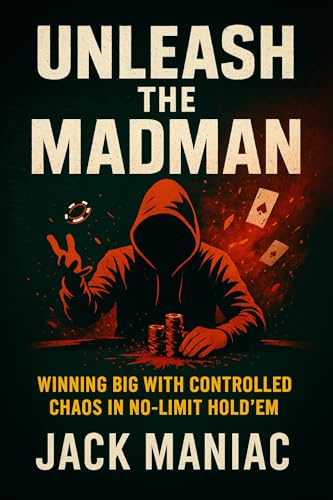
Bluff with a plan, not a prayer.
Unleash the Madman by Jack Maniac is the Controlled Chaos No-Limit Hold’em playbook: overbet bluffs, semi-bluff lines, stop-firing signals, and the Tilt Trigger System. $9.99 on Kindle, or read it on Kindle+.
Get Unleash the Madman: $9.99 on Kindleor read it on Kindle+Read a free sample