Controlled Chaos Poker Strategy
Controlled Chaos poker is aggressive No-Limit Hold’em with a leash. You fire when fold equity and a plan say yes. You stop when calling stations, the wrong board, or your own tilt say no. The name comes from Unleash the Madman by Jack Maniac — this page is the free outline of that system, with the fold math and the links to each pillar.
What Controlled Chaos means
Most “play aggressive” advice stops at raising more. Controlled Chaos is the opposite of that: every bet has a reason, and the reason is checked against real filters. The chaos is the pressure you put on opponents who fold too much. The control is knowing when that pressure stops printing money.
- Fire when: he folds enough for your size, the board favors your range, you have a turn plan (or real outs as a semi-bluff), and you are not steaming.
- Stop when: he never folds, you are out of position with a weak range, the board hits him better than you, or you are on tilt yourself.
That pair of rules is the whole system. The rest of this page is how the book teaches you to apply them.
The fold math behind every fire
A pure bluff breaks even when the opponent folds bet ÷ (pot + bet) of the time. Controlled Chaos starts here, not with “I feel like betting”:
| Bet size | He must fold at least |
|---|---|
| ⅓ pot | 25.0% |
| ½ pot | 33.3% |
| ¾ pot | 42.9% |
| Pot | 50.0% |
| 1.5× pot | 60.0% |
| 2× pot | 66.7% |
A half-pot bet needs folds only 33.3% of the time. A pot-sized bet needs 50.0%. A 2× overbet needs 66.7%. Most low-stakes players fold far more than a third of the time on boards that miss them — that gap is the profit. Semi-bluffs need fewer folds than the table shows, because you still win some of the time when called: a flush draw hits the turn 19.1% of the time (9 outs of 47). Work a spot with outs included in the fold equity calculator, size your bluff frequency with how often to bluff, and check the river balance on the bluff-to-value ratio page.
Pillar 1: Overbet and semi-bluff filters
Controlled Chaos does not overbet for style. An overbet is for when his range is capped, the board is polarized, or you want to charge draws while still having fold equity. A semi-bluff is for draws with enough outs that the break-even fold % drops below what he actually folds. Three-question checks before either bet live on the overbet & semi-bluff filters article; the raw numbers are on the overbet chart and semi-bluff chart.
Pillar 2: Stop-firing signals
The leash is the part most aggressive players skip. Against a calling station, every bluff is a donation — value-bet thinner and stop firing. Against a sticky player on a board that hits him, give up. Against your own tilt, the “aggression” is just bigger mistakes. The five stop signals are spelled out in stop firing at calling stations; the step-by-step habits that get you from passive to controlled aggression are in how to play aggressive poker.
Pillar 3: Tilt Trigger System (opponents, not self-help)
The Tilt Trigger System in the book is about opponents on tilt: spotting when someone is steaming, revenge-tilting, or playing scared, then adjusting your bets to that state. It is not a mindfulness course. Four opponent tilt types and how to pressure each one: Tilt Trigger System and poker tilt types. The mindset framing — decisions, not moods — is on poker mindset. If you are the one tilting, that is a different problem — use how to stop tilting and the tilt check before the next orbit.
The book: Unleash the Madman
Unleash the Madman: Winning Big with Controlled Chaos in No-Limit Hold’em by Jack Maniac is the short playbook this page outlines. It covers the fold math, overbet bluffs that make calling uncomfortable, semi-bluff lines that pay when you hit and still pressure when you miss, the stop-firing rules against calling stations, and the Tilt Trigger System for finding and pressuring players on tilt — with real hand examples from $1/$2 through $25/$50. It is about 41 pages: one sitting, then try one idea at your next session. It is not for absolute beginners who still need hand rankings and basic position.
It is $9.99 on Kindle, or read it on Kindle+. More picks in this style: best poker books for aggressive players. The broader LAG frame lives on LAG poker strategy.
FAQ
What is Controlled Chaos poker?
Controlled Chaos is the aggressive No-Limit Hold'em system from Unleash the Madman by Jack Maniac: you bet and raise when fold equity plus a plan say yes, and you stop when calling stations, the wrong board, or your own tilt say no. Aggression with a leash, not wild betting.
How is Controlled Chaos different from reckless aggression?
Reckless aggression fires every street at every player. Controlled Chaos filters every bet: does he fold enough for this size, do you have a turn plan, and are you on tilt yourself? If any answer is no, you check or give up. The leash is what keeps the style profitable.
Is Controlled Chaos the same as LAG poker?
It sits inside a loose-aggressive (LAG) style, but it is more specific. LAG describes playing many hands and raising a lot. Controlled Chaos adds the filters: fold math, overbet and semi-bluff rules, stop-firing signals, and the Tilt Trigger System for opponents on tilt. See the LAG poker strategy guide for the broader style.
Where can I learn Controlled Chaos poker?
Unleash the Madman by Jack Maniac is the playbook: overbet bluffs, semi-bluff lines, when to stop firing, and the Tilt Trigger System, with hand examples from $1/$2 through $25/$50. It is about 41 pages. It is $9.99 on Kindle, or you can read it on Kindle+.
Free email course
Free 5-day Controlled Chaos email course: one short lesson a day on when to fire, when to stop, and how to keep your aggression controlled. No fluff.
Related guides
Poker mindset
Controlled Chaos filters and the Tilt Trigger System.
How to play aggressive poker
7 steps from passive to aggressive, with fold math.
Low stakes poker strategy
Exploit sticky games: thin value, stop-firing, fold math.
Thin value bet poker
Value thinner, bluff less — especially vs calling stations.
When to overbet in poker
Fold math and filters for oversized bets.
How to play against calling stations
Stop bluffing sticky callers; value thinner instead.
When to c-bet in poker
Continuation-bet fold math: when to fire and when to check.
When to 3-bet in poker
Preflop re-raise fold math: when light 3-bets print.
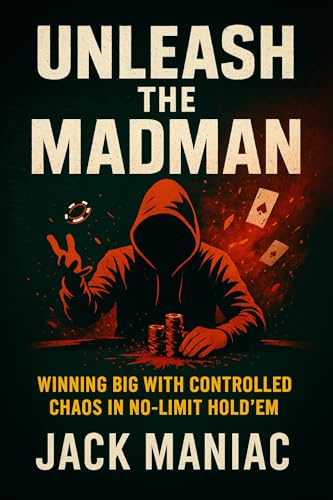
Get the Controlled Chaos playbook.
Unleash the Madman by Jack Maniac is the Controlled Chaos No-Limit Hold’em system: overbet and semi-bluff filters, stop-firing signals, and the Tilt Trigger System. $9.99 on Kindle, or read it on Kindle+.
Get Unleash the Madman: $9.99 on Kindleor read it on Kindle+Read a free sample