How to Play Aggressive Poker
Playing aggressive poker means betting and raising instead of checking and calling, so you win pots when you have the best hand and when your opponent folds. Going from passive to aggressive is a set of habits, not a personality. Here are the seven to build, in the order that costs you the least money while you learn them.
Why aggression wins: the fold math
A call only wins at showdown. A bet also wins every time he folds. For a pure bluff, he has to fold bet ÷ (pot + bet) of the time for the bet to break even:
| Bet size | He must fold at least |
|---|---|
| ⅓ pot | 25.0% |
| ½ pot | 33.3% |
| ¾ pot | 42.9% |
| Pot | 50.0% |
| 2× pot | 66.7% |
Most low-stakes players fold far more than a third of the time to a half-pot bet on boards that miss them. That gap is where aggressive players make their money. Semi-bluffs need fewer folds than the table shows, because you still win some of the time when you’re called. The fold equity chart works it out with your outs included.
Seven steps from passive to aggressive
1. Get loose in position first
Open more hands from the cutoff and the button, where you act last after the flop. Widening your early-position range buys you hard spots, not profit. The poker positions guide shows the seat order.
2. Raise or fold, don’t limp
Limping and flat-calling give up the initiative, and the initiative is what makes your later bets believable. Replace your limps with raises, or fold the hand. The few spots where a limp is fine: when to limp in poker.
3. 3-bet the stealers
Players who open wide from late position fold to 3-bets more than they should. 3-bet them with your value hands and some suited hands that play well. Start with the 3-bet chart.
4. C-bet the dry boards, small
A board like K♣7♦2♠ hits the preflop raiser’s range far more than the caller’s. A small continuation bet works often and risks little. See the c-bet chart for which boards to bet and which to check.
5. Bet your draws
Your first bluffs should be hands with outs. A flush draw bet half pot on the flop needs folds only 33.3% of the time as a pure bluff, and when he calls you still hit your flush on the turn 19.1% of the time (9 outs of 47 unseen cards). The semi-bluff chart lists the draws worth betting.
6. Keep betting the scare cards
When the turn brings an ace, or a card that fits your range better than his, fire a second barrel. When it changes nothing and he looks sticky, give up. The double barrel chart sorts good and bad turn cards.
7. Know when to stop
Aggression only prints against players who fold. Against a calling station, bet your value hands thinner and stop bluffing. And when you are steaming, your “aggression” is just tilt with bigger bets: use the stop rules before it costs you a buy-in.
Common mistakes when you start playing aggressive
- Bluffing the wrong player. Someone who has called three streets with second pair will do it again.
- Aggression out of position. 3-betting wide from the blinds against a tight opener is how new aggressive players go broke.
- No plan for the turn. Decide on the flop which turn cards you will keep betting.
- Bluffs with no reason. A scare card, a capped range, or a player who folds too much. “I want this pot” isn’t a reason.
- Forgetting value. Because you bet so often, your big hands get paid. Bet them.
Want the full loose-aggressive framework, with ranges and stats? Read the LAG poker strategy guide and LAG vs TAG.
The book this guide is built on
Unleash the Madman: Winning Big with Controlled Chaos in No-Limit Hold’em by Jack Maniac is a short playbook for exactly this step: turning a tight, careful game into controlled aggression. It covers overbet bluffs that make calling uncomfortable, semi-bluff lines that pay when you hit and still pressure when you miss, how to apply heat in cash games and tournaments, and the Tilt Trigger System for finding and pressuring players on tilt, with real hand examples from $1/$2 through $25/$50. It is about 41 pages, so you can read it in one sitting and try one idea at your next session. It is not for absolute beginners who still need hand rankings and basic position.
More picks for this style: best poker books for aggressive players.
FAQ
How do you play more aggressive poker?
Start in position: open more hands from the cutoff and button, raise instead of limping, and 3-bet players who steal too often. After the flop, c-bet dry boards with a small size, bet your draws as semi-bluffs, and keep betting turn cards that help your range. Every bluff needs a reason, and you stop bluffing players who have shown they don't fold.
Is aggressive poker better than passive poker?
Usually, yes. A bet or raise can win the pot two ways, when the opponent folds or when you have the best hand, while a call only wins when you have the best hand at showdown. Aggression without a plan is spew, though: the profit comes from picking spots, sizes and opponents.
How often does a bluff need to work?
A pure bluff breaks even when the opponent folds bet ÷ (pot + bet) of the time: 33.3% for a half-pot bet, 50% for a pot-sized bet. Semi-bluffs need fewer folds because you can still hit your draw.
When should you stop being aggressive?
Against calling stations, when you are out of position with a weak range, when the board hits the caller better than you, and when you are tilted yourself. Against players who never fold, value-bet thinner and stop bluffing.
What is the best book for learning aggressive poker?
Unleash the Madman by Jack Maniac is a short loose-aggressive No-Limit Hold'em playbook built on controlled aggression: overbet bluffs, semi-bluff lines, when to stop firing, and the Tilt Trigger System for exploiting players on tilt. It is $9.99 on Kindle, or you can read it on Kindle+.
Free email course
Free 5-day Controlled Chaos email course: one short lesson a day on when to fire, when to stop, and how to keep your aggression controlled. No fluff.
Related free tools
Maniac or nit? Player type test
Eleven questions: nit, TAG, station, Controlled Chaos or maniac?
Where to play poker online
Bovada vs BetOnline for practicing the book's lines at low stakes.
When to raise in poker
Value, bluff or isolation: raise sizes and bluff-raise fold math.
Controlled Chaos poker
The book's aggression-with-a-leash system: filters, stop signals, TTS.
How to play against a maniac
Call wider, trap, skip the bluffs, and stay off revenge tilt.
Low stakes poker strategy
Exploit sticky games: thin value, stop-firing, fold math.
When to overbet in poker
Fold math and filters for oversized bets.
How to play against calling stations
Stop bluffing sticky callers; value thinner instead.
When to c-bet in poker
Continuation-bet fold math: when to fire and when to check.
LAG poker strategy
Five rules and a worked $1/$2 hand.
When to 3-bet in poker
Preflop re-raise fold math: when light 3-bets print.
When to limp in poker
Open-limp vs over-limp vs completing, with a $1/$2 price table.
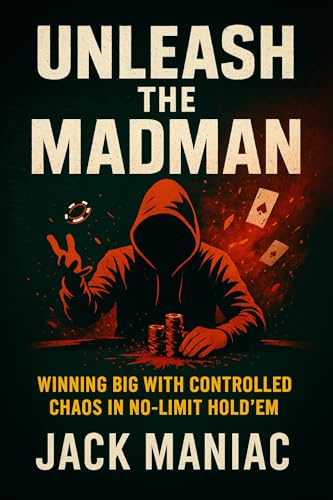
Play like a madman, with a plan.
Unleash the Madman by Jack Maniac is the controlled-aggression No-Limit Hold’em playbook: overbet and semi-bluff lines, the signs to stop firing, and the Tilt Trigger System. $9.99 on Kindle, or read it on Kindle+.
Get Unleash the Madman: $9.99 on Kindleor read it on Kindle+Read a free sample